Narrative Theology Explained: Finding the Sacred Thread in Your Story

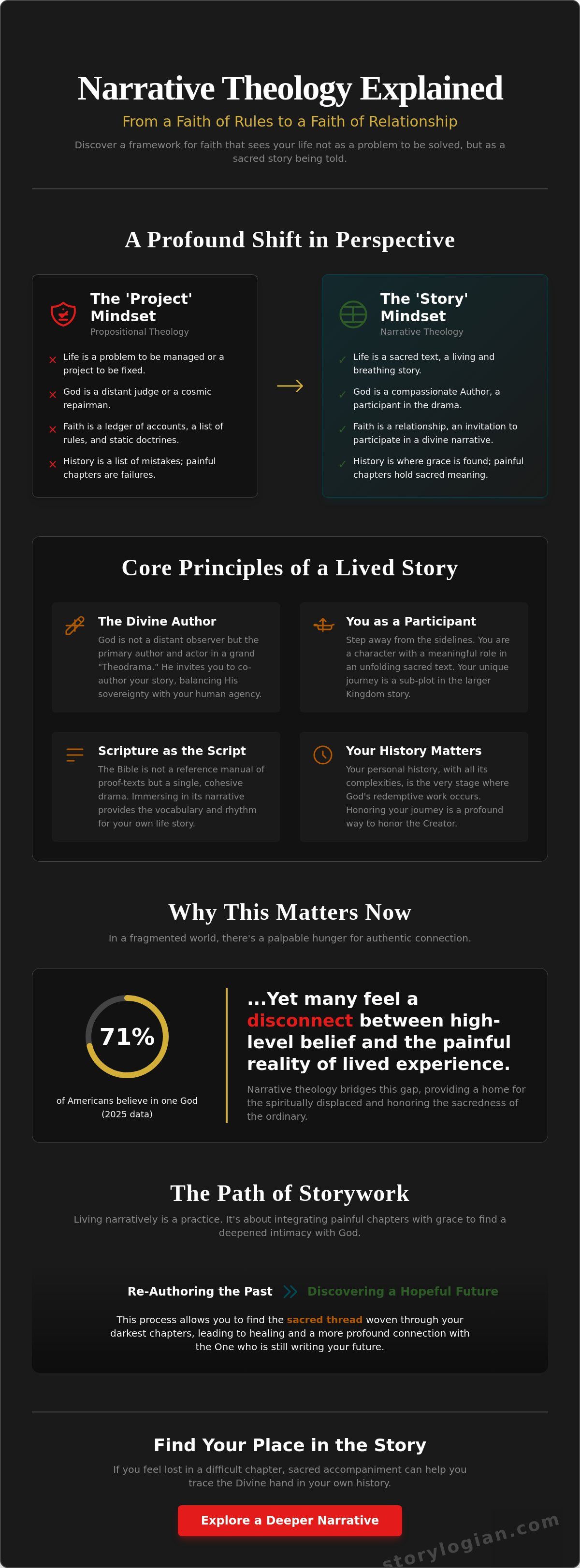
What if your life is not a project to be managed or a series of broken parts waiting for a repairman? You might often feel like a collection of abstract doctrines that don't quite fit the shape of your Monday mornings. It's exhausting. It's lonely. To have narrative theology explained is to find a different way forward, one that invites you to see your history not as a list of mistakes, but as a sacred text. You are not an equation God is trying to balance.
Many of us carry the weight of unprocessed stories, feeling a disconnect between high-level theology and the quiet, painful reality of our lived experiences. This approach transforms your understanding of the Divine from a distant judge into a compassionate Author. It provides a framework for healing your personal history by finding the sacred thread woven through your darkest chapters. We will explore how to re-author your past and discover a deepened intimacy with the One who is still writing your future.
Key Takeaways
Step away from the weight of rigid rules and enter a landscape where faith is a living, breathing story. Having narrative theology explained helps you see that you are a participant in a divine drama rather than a project to be fixed.
Discover the role of the Divine Author. This framework invites you to find sacred meaning in every chapter of your life, no matter how quiet or complex it may feel.
Understand why your personal history matters. Honoring your unique journey is a profound way to honor the Creator who has been present in every moment of your existence.
Explore how the path of storywork allows you to integrate painful chapters with grace. This process leads to a deeper, more intimate connection with the God who is still writing your future.
Table of Contents
What is Narrative Theology? An Invitation to the Story
Faith is not a ledger of accounts. It isn't a manual of cold, static propositions or a list of rules meant to flatten the human experience. Instead, having narrative theology explained reveals a landscape where faith is a living, breathing story. It's the conviction that God doesn't just give us information; God gives us a drama. We are invited to stop observing from the sidelines and start participating as characters in an unfolding sacred text. Our brains are hardwired for this. From the earliest campfires to the way we process our daily lives, we make sense of the world through sequence, character, and conflict. God uses this natural architecture of the mind to draw us into a relationship that feels like home.
The Core Shift: From Rules to Relationships
There's a profound difference between knowing about someone and actually knowing them. Clinical faith often focuses on the former, treating God like a subject to be studied under a microscope. Narrative thought shifts the focus. It moves us from propositions toward participation. This shift requires the imagination. It's the faculty that allows us to see the burning bush not just as a historical event, but as a current invitation. When we seek to have narrative theology explained in the context of our own history, we move away from a transactional spirituality and toward a soulful, lived experience. It's about witnessing the Divine in the texture of our days.
Why Narrative Theology Matters in 2026
In a world that feels increasingly fragmented and digital, the hunger for something authentic is palpable. As of 2025, while 71% of Americans still agree there's one true God in three Persons, many feel a disconnect between that belief and their daily experiences. Story provides a home for those who feel spiritually displaced by rigid systems. It honors the sacredness of the ordinary. Often referred to as postliberal theology, Narrative Theology suggests that we understand our identity through the lens of a shared, communal story. In 2026, this approach offers a steady, unhurried rhythm. It allows us to breathe. It reminds us that even the quietest chapters of our history are being held by a steady hand. You are not a problem to be solved; you are a story being told.
The Divine Author and the Great Theodrama
Imagine the universe as a vast, unfolding theater. It's not a cold machine. It's a stage. In this sacred space, God acts as the Divine Author who doesn't merely watch from the balcony. He enters the scene. This is the essence of the 'Theodrama,' a concept that views the world as the primary setting for God's redemptive action. When you have narrative theology explained, you see that your life isn't a series of random accidents. It's a sub-plot in a much larger, more beautiful story. You are invited to pick up the pen alongside the Creator, balancing the weight of His sovereignty with the dignity of your own human agency.
Scripture serves as our script. It doesn't give us every line, but it gives us the character of the Lead Actor. It provides the rhythm. We are called to a faithful improvisation, living out the themes of the Great Story in our own specific time and place. This way of having narrative theology explained reminds us that we aren't just reading a book; we're living a role. It's a performance of grace.
Scripture as the Primary Narrative
The Bible is a single, cohesive drama. It moves with a steady grace from the dust of the garden to the gold of the new city. Many of us were taught to treat the text like a reference manual, pulling out 'proof-texts' to win arguments or fix problems. But there's a deeper beauty in story-dwelling. By immersing ourselves in the overarching narrative, we find the vocabulary for our own internal landscapes. As discussed in The Gospel Coalition on Narrative Theology, this approach prioritizes the dramatic flow of God's work over a list of static propositions. It allows the Word to breathe within us.
Your Life as a Sub-Plot in the Kingdom
Your history is not a distraction from the 'real' work of God. It's the very place where that work happens. Even the chapters that feel silent or forgotten are held by the Author. In this framework, narrative identity is the intersection of memory and hope. It's the process of looking back to see where grace was hiding and looking forward to where it's leading. If you feel lost in a difficult chapter, you might find clarity through sacred accompaniment, allowing another to help you trace the Divine hand in your own history. Your story matters because the Author of all stories has chosen to include you in His own.
Moving Beyond Propositions: Why Your History Matters
A common hesitation arises when we begin to prioritize our own experiences. Is focusing on 'my story' selfish? Is it unbiblical to look so closely at our own internal landscapes? Some fear that this path leads to a subjective whim where truth is lost in a sea of personal feelings. However, if we view God as the Great Author, then our history is the very canvas He has chosen for His work. Honoring your story is not an act of narcissism. It's an act of reverence for the Creator's craftsmanship. When we have narrative theology explained as a tool for healing, we realize that naming the harm we've endured is not just a psychological exercise. It's a theological necessity. Truth-telling is the first step toward redemption.
We must distinguish between a fleeting emotion and a sacred witness. A sacred witness is the quiet, persistent voice that recognizes God's presence even in the wreckage. While The Gospel Coalition provides an in-depth essay on Narrative Theology that explores its academic roots, the lived reality is far more intimate. It's about finding the sacred thread in the mess of our actual lives. It's about believing that God is big enough to handle our questions, our anger, and our silences.
The Sacredness of the Shadow Chapters
Not every story has a tidy ending. Our lives are often filled with 'dark nights' and seasons where the heavens seem like brass. Narrative theology allows for this complexity. It creates space for the unresolved. Instead of rushing toward a forced resolution, we are invited to practice lament. Lament is the language of the shadow chapters. It's the honest cry that refuses to pretend things are okay when they aren't. By dwelling in these difficult parts of our arc, we discover that God is often most present in the parts we try to hide.
Healing from 'Church Hurt' Through Story
Rigid dogmas can sometimes act as a heavy weight, silencing the individual's sacred voice in favor of a uniform script. This often leads to deep spiritual trauma. To move toward healing from church hurt, one must reclaim their own narrative. It's about moving from being a 'project' of the institution to being a character in God's kingdom. Using narrative allows you to integrate your past rather than amputating it. It fosters a faith that feels safe, honest, and profoundly integrated with who you truly are.
Living Narratively: Practices for Spiritual Discovery
To have narrative theology explained is only the beginning. The real work happens in the quiet spaces of your day. It's a slow turning of the heart toward the texture of your own experience. How do you begin to see the Divine in the mundane? It starts with a question. What is the Author doing here? You must learn to look at your life not as a problem to be solved, but as a manuscript to be read. This requires silence. It requires a willingness to sit with the complexity of your own heart without rushing to edit the messy parts. By living this way, you find that having narrative theology explained becomes a daily practice of listening rather than just an academic theory.
This posture of awareness allows you to notice the subtle movements of grace. It's about developing a narrative eye. You begin to see that even the interruptions and the detours have a place in the larger arc. You are not just reacting to events. You are participating in a story that is being told through you. This awareness is the foundation of deep spiritual discovery.
The Practice of Spiritual Autobiography
Writing your story is a way of honoring the life God has given you. You don't need to be a literary expert. You only need to be a witness. Consider these steps to begin your own reflection:
Step 1: Identify turning points. Look for the moments that changed the direction of your path. These are your inciting incidents. They are the places where grace broke through or where the struggle deepened.
Step 2: Look for recurring themes. Is there a thread of longing? A pattern of rescue? Notice the metaphors that naturally emerge when you describe your history.
Step 3: Invite a witness. Stories are meant to be heard. Finding someone to honor your unfolding narrative creates a sense of sacredness that solitude cannot provide.
Sacred Listening and Soul Care
We often struggle to hear the Author's voice because the critic's voice is so loud. The critic speaks in "shoulds" and "oughts." The Author speaks in invitations. Distinguishing between these two requires a steady, guided movement. This is why many find peace in spiritual direction for women. It provides a container for your questions. A spiritual director acts as a holder of space, helping you read the subtext of your life with clarity and compassion. They don't fix the story. They witness the process of its unfolding.
If you feel the need for a patient guide to help you interpret the chapters of your past, consider booking one of our Storywork Sessions to begin your journey of discovery. You deserve to have your story heard with reverence.
Re-Authoring with Hope: The Path of Storywork
The movement from understanding a theory to experiencing a shift in one's own history is where the sacred thread is finally pulled taut. To have narrative theology explained is to realize that the Author hasn't finished your manuscript. Grace is the ink that allows for a rewrite. It doesn't erase the ink that came before, but it changes the meaning of the sentences. This is the heart of integration. You are not just a collection of events. You are a living testimony. Having narrative theology explained serves as the bridge between the abstract and the ache of our daily lives.
Integration is not forgetting. We are often told to "move on" or "leave the past behind," but narrative theology suggests a more patient path. It asks us to bring our whole selves, including the broken chapters, into the light of the Great Story. When we integrate our history, we stop being haunted by it. We begin to see how even the seasons of profound spiritual or personal trauma were held within a larger, redemptive arc. This is where the quiet unrest begins to settle into wisdom.
Transforming Your Past into a Narrative of Hope
Storywork acts as a contemplative, faith-based intervention. It's the practice of looking at the themes of harm in our lives and asking how they might be transformed into themes of restoration. This isn't about positive thinking or a quick fix. It's about deep, honest listening. In a safe and sacred space, your story is witnessed. To be seen in your complexity, without judgment, is a powerful catalyst for healing. It moves the narrative from a series of random wounds to a testimony of endurance and grace. We look for where the Divine has been hiding in the subtext of your life.
Next Steps for Your Journey
Your story is still unfolding. The chapters written in tears do not have the final word. If you feel a quiet unrest or a longing to see your life through this sacred lens, seeking a storywork session can be the beginning of a new clarity. It's an invitation to stop being a project and start being a participant in your own redemption. You don't have to carry the weight of an uninterpreted past alone. There is space here for your questions and your silence.
May you find the courage to look back with kindness. May you trust the Author who began a good work in you to bring it to completion. The pen is still moving. The ink is still wet. If you are ready to begin this process of discovery, book a discovery call today to explore how your sacred narrative is being written.
Stepping Into Your Sacred Narrative
Your story is not a static document. It's a living text. Having narrative theology explained is simply the first step toward a deeper, more integrated faith where your history is honored rather than ignored. You've discovered that your past is not a series of accidents, but a landscape where the Divine Author has been present in every chapter. By shifting from abstract propositions to active participation in the theodrama, you find the freedom to re-author your future with hope.
If you're ready to move from theory into the sacred work of your own life, we invite you to experience a deeper level of healing. Led by Dr. Shonda Carter, a theologian and filmmaker, our work is rooted in the quiet strength of sacred accompaniment and contemplative prayer. These sessions are designed specifically for women seeking spiritual wholeness and a way to integrate their unique history with grace. You can begin your journey of re-authoring with a Storywork Session today. The pen is in your hand, but you don't have to write the next chapter alone. Your story is sacred. It's worthy of being heard.
Frequently Asked Questions
What is the main idea of narrative theology?
The main idea is that faith is best understood as a living story rather than a collection of abstract rules or manual of doctrines. It suggests that God reveals His character through the unfolding drama of history and scripture. Instead of merely analyzing concepts, we are invited to enter into the narrative of God's work. Having narrative theology explained in this way allows us to see our own lives as sacred chapters in a larger, ongoing tale.
How is narrative theology different from systematic theology?
While systematic theology organizes faith into logical categories and propositions, narrative theology prioritizes the flow of the story. Systematic approaches often look for universal truths that exist outside of time. In contrast, a narrative approach finds truth within the specific, messy, and time-bound events of the biblical record. It values the texture of experience over clinical precision. It is the difference between a poem and a textbook.
Is narrative theology biblical?
Yes, it is deeply rooted in the structure of the Bible itself. A significant portion of the Old Testament is narrative, and the Gospels are primarily stories of the life of Jesus. Scripture does not present itself as a dictionary of terms but as a history of God's relationship with humanity. By following the arc from creation to new creation, we honor the way the text was actually written and delivered to us.
Who are the key thinkers in narrative theology?
Key figures often associated with this movement include Hans Frei and George Lindbeck, who were part of the Yale School of theology. They emphasized the internal logic of the biblical story. Other influential voices include Stanley Hauerwas, who explores how the church's story shapes its ethics, and N.T. Wright, who views the New Testament through the lens of a continuing drama. These thinkers help ground the concept in historical scholarship.
How can narrative theology help me heal from trauma?
It offers a framework for re-authoring the painful chapters of your history. Trauma often leaves us feeling like our story has been stolen or broken beyond repair. This approach invites you to look for the sacred thread of grace that was present even in the darkness. By witnessing your history through the lens of the Great Story, you can begin to integrate your pain. It helps you reclaim your agency as a character held by a loving Author.
What does it mean to see God as an 'Author'?
Seeing God as an Author means trusting that there is intentionality and purpose in the unfolding of your life. It is a metaphor that suggests God is not a distant observer but a creative participant who is still writing. Having narrative theology explained through this lens reminds us that the middle of a story is often confusing. Yet, we can rest in the knowledge that the Author knows where the plot is leading and remains present in every scene.
Can narrative theology be used in spiritual direction?
It is a foundational tool in spiritual direction and sacred accompaniment. A director helps you read the subtext of your life, listening for the quiet movements of the Spirit that you might miss on your own. Together, you look for the recurring themes and turning points that define your journey. This practice transforms your daily experiences from random events into a deliberate dialogue with the Divine. It is a way of honoring your unique sacred narrative.
Does narrative theology deny objective truth?
It does not deny truth, but it changes how we encounter it. Rather than seeing truth as a set of detached facts, this approach sees it as something lived and embodied. It suggests that the most profound truths are found within the context of a relationship and a story. Truth isn't less objective; it is simply more personal. It is a truth that has skin on it, much like the Word becoming flesh in the story of Jesus.


Comments