The Unhurried Soul: A Guide to Soul Care for Ministry Leaders

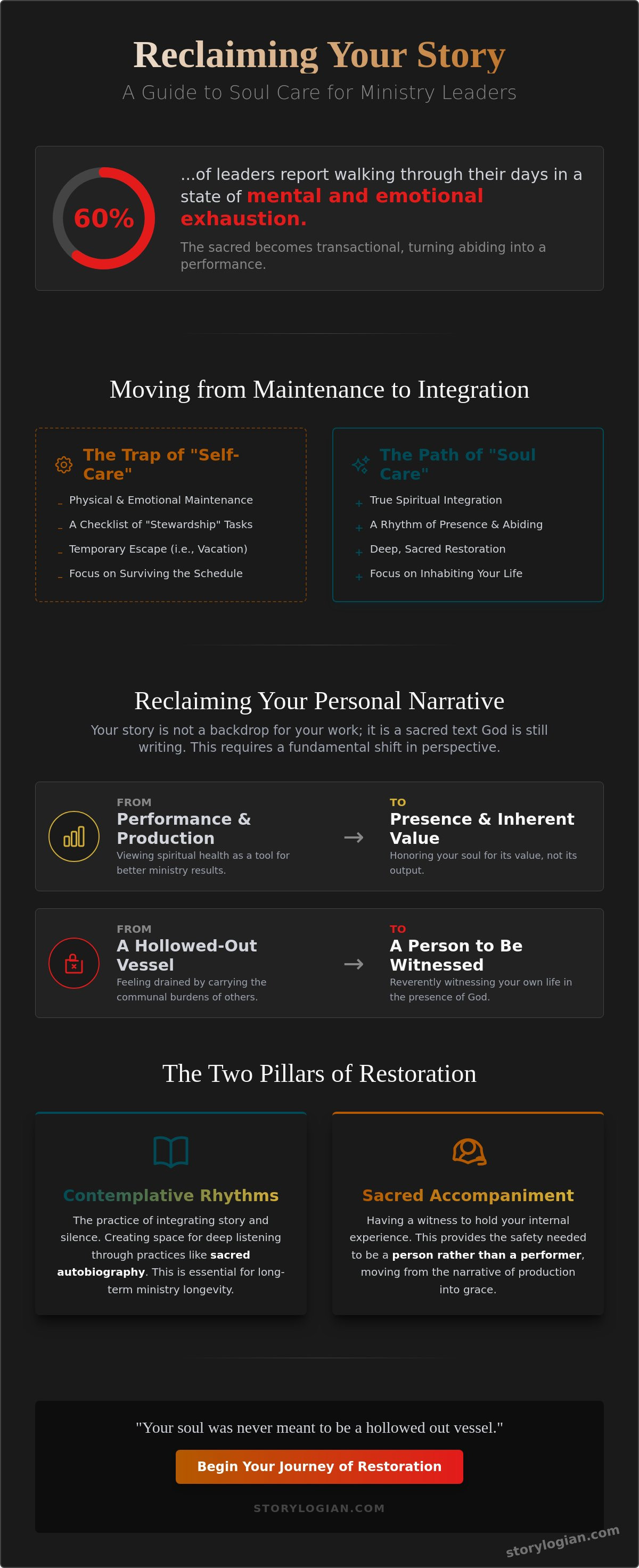
You are a person. Not a performance. Not a productivity metric. It's easy to forget this truth when the weight of other people's stories begins to press against the fragile edges of your own. While 2026 data suggests a stabilization in burnout rates, Barna reports that 60% of us still walk through our days in a state of mental and emotional exhaustion. You might find yourself wondering how to practice soul care for ministry leaders when every ounce of your spiritual strength is already promised to someone else. It's a quiet, heavy loneliness that turns the sacred into the transactional.
We agree that your soul was never meant to be a hollowed out vessel for the needs of others. This article promises a path toward deep, sacred restoration through a narrative-based approach that moves far beyond simple burnout prevention. We will explore how to reclaim your own story, move from spiritual dryness into integrated wholeness, and establish a sustainable rhythm of presence that honors both your soul and your Savior.
Key Takeaways
Learn to distinguish between physical maintenance and true spiritual integration. This shift allows you to move from simply surviving your schedule to deeply inhabiting your life.
Discover how soul care for ministry leaders involves reclaiming your personal narrative from the shadow of communal burdens. Your story is more than just a backdrop for your work.
Release the pressure to see your spiritual health as a tool for better performance. God honors your soul for its inherent value, not for its capacity to produce results.
Explore the restorative power of contemplative silence and sacred autobiography. These rhythms create the space needed for deep listening and long term ministry longevity.
Understand why having a witness to hold your internal experience is vital for your health. Sacred accompaniment offers the safety needed to be a person rather than a performer.
Table of Contents
What is Soul Care for Ministry Leaders?
The sacred has become a job. It is a strange, quiet grief to realize that the God you once loved has become the God you merely manage. For many, the practice of soul care for ministry leaders is often reduced to a checklist of "stewardship" tasks, as if the soul were a machine requiring oil rather than a living landscape requiring presence. Throughout the history of pastoral care, the emphasis has often shifted between tending to the flock and the vital necessity of the leader’s own spiritual integration. Soul care is the intentional act of attending to your internal landscape and your relationship with the Divine. It's not a performance. It's an abiding. Jesus spoke of abiding as a state of being, not a metric of productivity. When we professionalize the sacred, we risk losing our own connection to the very Mystery we proclaim to others. This is the unique occupational hazard of ministry. We become experts in the language of faith while our hearts grow increasingly silent. While self-care might offer physical or emotional maintenance through a walk or a meal, soul care seeks spiritual integration. It's the slow, patient work of making sure your life and your labor are no longer at war.
The Distinction Between Performance and Presence
We often substitute religious activity for actual spiritual intimacy. We pray for others while forgetting how to pray for ourselves. We lead others into the presence of God while remaining at the threshold ourselves. This creates a hollowed-out feeling. You begin to give what you no longer possess. It is a dangerous, quiet exhaustion that leaves you feeling like a performer rather than a person. You are not a vessel to be drained, but a child to be held. Soul care is the reverent witnessing of one’s own life in the presence of God. It asks you to stop performing and start simply being. It requires the courage to be seen by God without your title or your credentials.
Why Traditional Rest Often Fails the Ministry Leader
A week at the beach won't heal a soul that is misaligned with its own story, which is why soul care for ministry leaders must go deeper than a simple day off. Vacation is often just a temporary escape from the weight of leadership. But the weight remains when you return. Rest is not "checking out" from your reality. It is "leaning in" to the Spirit. True restoration requires more than silence; it requires a witness. It requires a space where your story can be told without the need for a sermon or a strategy. This is why we often emphasize the need for Sacred Accompaniment. You need someone to help you listen to what your life is saying when you are finally quiet enough to hear it. It is about moving from the narrative of production into the narrative of grace.
The Narrative Cost of Leadership: When Your Story Gets Lost
Your story has been quiet for a long time. In the relentless rhythm of ministry, the leader's personal narrative is often the first thing to be sacrificed. You carry the weight of other people's grief, their questions, and their crises, until your own internal voice becomes a faint whisper. This isn't just about being busy. It's about the shadowing of your heart. When you carry communal trauma, it leaves a residue. Research from Duke University's Clergy Health Collaborative suggests that spiritual well-being is intricately tied to how we process this stress. If we don't name our own experiences, they begin to haunt us. Soul care for ministry leaders requires us to stop being the spiritual provider for a moment and remember that our own story is sacred. It has inherent value to God, quite apart from what we do for the institution.
We often use Storywork as a tool to uncover these buried themes. It's a way of looking back at the moments where the weight of leadership felt like too much. You might find that your ministry history is marked by seasons of quiet harm or profound loneliness. These are not failures. They are chapters that deserve to be read with compassion. By identifying these themes, we begin to see where our humanity has been eclipsed by our position. We stop being a function and start being a person again. Your history isn't just a series of events; it's a sacred text that God is still writing.
Naming the Shadows: Healing from Church Hurt
It's a particular kind of ache to be wounded by the very community you serve. The betrayal feels more acute when it happens in the sanctuary. Many leaders carry these scars in silence, fearing that speaking up would undermine the mission. But naming the harm is the only way to move toward healing from church hurt. It's the first step in re-authoring a narrative of hope rather than resentment. You don't have to carry the shame of what happened to you. When we bring these shadows into the light, we find that God is present in the pain, not just the success. If you feel the need to begin this process, engaging in Storywork Sessions can provide the safe container your heart needs.
Reclaiming Your Humanity from the Institution
The Pastoral Persona is a heavy mask. It's a role that demands perfection, wisdom, and constant availability. Over time, that mask can fuse to your face. You forget where the leader ends and the person begins. Reclaiming your humanity means rediscovering your primary identity as a beloved child of God. You are not a spiritual provider first. You are a human being who needs grace just as much as the people in the pews. It takes immense courage to be human in a culture of perfection. It requires a willingness to be unhurried and unfinished. You are allowed to have needs. You are allowed to have a story that isn't yet resolved. Soul care for ministry leaders begins when you allow yourself to be a person again.
Beyond Stewardship: Reclaiming Your Soul from the Narrative of Production
Your soul is not a tool. It is not an asset to be managed for the sake of a growing congregation or a successful capital campaign. In many leadership circles, soul care for ministry leaders is often framed as "maintenance," a necessary oil change to keep the machine of the institution running. This is a subtle, dangerous lie. It suggests that your value lies solely in your utility. God does not love you because you are useful. He loves you because you are His. Reclaiming your soul requires stepping out of the narrative of production and into a theology of the ordinary. It means finding the Divine in the unproduced moments. The quiet morning air. The walk where no sermon is composed. The silence where no one is asking for your wisdom. When we view our internal lives through the lens of Denver Seminary's Soul Care Initiative and similar restorative frameworks, we see that the goal isn't better work. It's a deeper life.
The Utility Trap: Why We Treat Our Souls Like Tools
Ministry culture often rewards the martyr. It applauds the "burnout for Jesus" mentality as if exhaustion were a spiritual gift. We treat our internal landscapes like a car that needs a quick tune-up just to return to the road. This "Stewardship for Production" model is a hollow way to live. It ignores the inherent, non-utilitarian value of the person. Contrast this with a "Presence for Relationship" model. Here, the goal is not to get back to work; the goal is simply to be with the One who made you. It is a shift from being a spiritual provider to being a spiritual participant.
Embracing the Slow Pace of the Spirit
The communication rhythm of the Spirit is slow. It is methodical. It is unhurried. Our ministry calendars, however, are often frantic. Practicing "holy idleness" is an act of resistance against the pressure to produce. It's a way of declaring that your soul is not for sale to the highest bidder of productivity. When you choose to slow down, you aren't being selfish. You are engaging in an act of worship. You are honoring the Creator by honoring the creation that is your own life. Integrating specific soul care practices allows you to move at the pace of grace rather than the pace of the institution. It is in this slow movement that the soul finally feels safe enough to emerge from hiding.
Contemplative Rhythms: Integrating Story and Silence
Silence is not a void. It is a presence. For those weary from the noise of the pulpit and the weight of the boardroom, silence is the necessary threshold where the performance ends and the person begins. Soul care for ministry leaders requires a return to this quiet center. It is here, in the absence of an audience, that we practice contemplative prayer as a form of deep listening. This is not about achieving a state of mental emptiness. It is about becoming a witness to the Spirit’s movement within your own heart. When we stop talking, we finally allow God to speak into the parts of our story that we have kept hidden, even from ourselves.
Integrating these rhythms of soul care for ministry leaders into your life is a matter of longevity. A ministry built solely on output will eventually crumble under its own weight. However, a life rooted in "sacred autobiography" allows you to see the thread of grace running through every season. This practice involves looking back at your history, not with the eyes of a critic, but with the curiosity of a child. You begin to see your life as a text where God is the primary author, and your role is to pay attention to the themes He is developing.
The Art of Spiritual Listening
The noise of ministry is loud. It demands answers, strategies, and constant availability. Spiritual listening is the art of hearing the "whisper" beneath that clamor. It is the ability to distinguish between the voice of the critic, which is often sharp and demanding, and the voice of the Spirit, which is profoundly gentle. To hear this whisper, you must create contemplative spaces in your schedule. This isn't a luxury. It's a lifeline. It might be ten minutes of sitting with a cup of tea in the morning or a slow walk through the woods. These spaces allow the sediment of your day to settle so you can see clearly again.
Storywork as a Spiritual Discipline
Journaling is a common practice, but narrative-based journaling goes deeper than a simple record of events. It's about meaning-making. When you look at your personal history, you often find "shadows," which are the painful ministry chapters where you felt betrayed, abandoned, or inadequate. Storywork as a spiritual discipline asks you to re-author these chapters. You look for the presence of God in the midst of the harm. You name the pain, but you also name the grace that sustained you. This deep work is often best done with a witness who can help you see the beauty you might have missed. Engaging in formal storywork sessions can provide the structure and safety needed to revisit these vulnerable parts of your narrative.
Before the day closes, practice the Examen. It is a simple way of witnessing your day in the presence of God. Where did you feel a sense of life? Where did you feel a pulling away? By noticing these movements, you begin to recognize the Spirit's pace. If you find your soul longing for a dedicated space to explore these rhythms, we invite you to consider our Spiritual Direction as a path toward integrated wholeness.
Sacred Accompaniment: Why Leaders Need a Witness
You are often the one holding the door open. Day after day, you listen to the brokenness of the world until your own ears ring with the weight of it. It is a lonely altitude. In the quiet work of soul care for ministry leaders, there comes a profound moment where you must stop being the shepherd and allow yourself to be led. We were never meant to carry the complexity of our own stories in isolation. We need a witness. We need someone who can sit with us in the silence, not to offer a quick theological fix or a new leadership strategy, but to simply honor the reality of our lives. This is the essence of Sacred Accompaniment. It is the brave act of allowing another to see the unedited pages of your heart.
Many leaders struggle to be the one being cared for. There is a deep, internal resistance to vulnerability that often stems from the "Pastoral Persona" we discussed earlier. You might feel that needing help is a sign of spiritual deficit. It isn't. It is a sign of your humanity. Taking the seat of the one being heard requires a different kind of strength. It is the strength of surrender. In a confidential, contemplative space outside the entanglements of your local church, you are free to be unfinished. You don't have to be the expert. You can simply be the beloved.
At StoryLogian, we don't view our work as a "fix-it" service. We aren't here to repair a broken tool so it can return to the production line. Instead, we see this as a sacred journey. We are here to witness and interpret the process of your restoration. This is a journey toward integrated wisdom, where the fragments of your ministry experience are gathered and held with reverence.
Finding a Guide for Your Internal Landscape
When you look for a guide, seek one who prioritizes deep listening over advice-giving. You need someone who understands the nuances of both theology and story. A true guide for the soul doesn't rush to fill the silence with platitudes. They hold the space until the truth has room to emerge. Dr. Shonda Carter’s unique background in filmmaking and theology creates a specific kind of witnessing space. Just as a filmmaker understands how light and shadow define a frame, she helps you see how the different elements of your history create a meaningful whole. This interdisciplinary approach allows for a richer exploration of your internal landscape, honoring the narrative arc of your life.
Taking the First Step Toward Wholeness
The first step is often the quietest. It is the simple decision to stop running and start listening. Your soul is worthy of the time it takes to heal. It is worthy of being heard. You have spent years listening to the stories of others; now, it is time to attend to your own. We invite you to step into a rhythm that honors your pace and your history. There is a place for you to be known without being used. There is a path toward a sustainable, unhurried life. Explore how Storywork Sessions can restore your soul.
Reclaiming the Sacred Narrative of Your Life
The path to an unhurried soul is not a destination you reach by working harder. It's a slow turning back toward the person God created you to be before the titles and the tasks took hold. We have explored how the narrative of production can silence your own story. We have seen why true soul care for ministry leaders requires more than a simple exit from the calendar. It requires a descent into the quiet, sacred spaces of your own history. You have seen that your soul has inherent value apart from your utility. Healing begins when you allow your story to be witnessed in a safe, contemplative environment.
You don't have to walk this landscape alone. Led by Dr. Shonda Carter, a theologian and filmmaker, our work offers a specialized focus on narrative-based spiritual growth within a deeply confidential space. Your story is a sacred text that deserves to be read with care. Begin your journey toward narrative healing with a Storywork Session. The Spirit is moving at the pace of grace. Take a breath. You are safe to slow down.
Frequently Asked Questions
How is soul care different from self-care for ministry leaders?
Self-care often addresses the physical and emotional edges of your life, such as sleep or a quiet walk. Soul care for ministry leaders goes deeper, focusing on spiritual integration and the intentional practice of attending to your relationship with the Divine. It moves you from temporary maintenance into a state of abiding. It's the difference between a brief escape and a profound, lasting restoration.
What are the signs that a ministry leader is suffering from a "hollowed-out" soul?
A hollowed-out soul often manifests as a feeling of being a performer rather than a person. You might experience chronic spiritual dryness, compassion fatigue, or a sense that you're giving what you no longer possess. It's a quiet, heavy exhaustion where your religious activity has replaced your actual intimacy with God. You find yourself carrying the heavy stories of others while your own narrative feels lost or silenced.
Can soul care really help with burnout if my ministry workload remains the same?
While soul care doesn't always decrease your external workload, it transforms your internal posture toward the weight you carry. It shifts your identity from a performer back to a person. By establishing a sustainable rhythm of presence, you learn to work from a place of wholeness rather than depletion. It allows you to reclaim your humanity from the narrative of production, even when the schedule remains demanding.
What is spiritual direction, and how can it help a pastor or leader?
Spiritual direction is a form of Sacred Accompaniment where a guide listens to your life alongside you. For a leader, it provides a rare, confidential space where you can finally be the one being cared for. It helps you discern the Spirit's whisper beneath the clamor of ministry demands. This practice isn't about fixing problems; it's about witnessing the holy movements within your internal landscape.
How does Storywork help in healing from church-related trauma?
Storywork facilitates healing by helping you name and re-author the painful chapters of your ministry history. By identifying themes of harm, you can begin to bring these shadows into the light of grace. This process allows you to move from being a victim of a painful narrative to a participant in a story of restoration. It honors the sacredness of your experience regardless of your title or position.
Is soul care biblical, or is it just a modern wellness trend?
Soul care is a deeply biblical practice, rooted in the ancient call to abide in the vine and find rest for your soul. It reflects the rhythms of the Sabbath and Jesus' own habit of withdrawing to quiet places to be with the Father. Unlike modern wellness trends that often center on self-improvement, soul care centers on the relationship between the creature and the Creator. It is a sacred integration.
How can I find time for soul care in an overbooked ministry schedule?
Finding time for soul care for ministry leaders begins with reframing it as an act of worship rather than a luxury. You can start by integrating small, contemplative rhythms like the daily Examen or ten minutes of silence. These moments of holy idleness act as a resistance to the pressure of production. When you honor the soul's pace, your ministry becomes a sustainable flow rather than a frantic race.
What should I expect in a Storywork session with StoryLogian?
In a Storywork session with StoryLogian, you can expect a deeply confidential and contemplative space where your personal narrative is held with reverence. Led by Dr. Shonda Carter, these sessions move beyond advice-giving into the art of deep listening. You'll be invited to explore your history with curiosity, identifying themes of grace and harm. It's a shared journey toward integrated wisdom, focusing on the sacredness of your individual story.


Comments