How to Process Spiritual Trauma: A Gentle Path Toward Narrative Healing

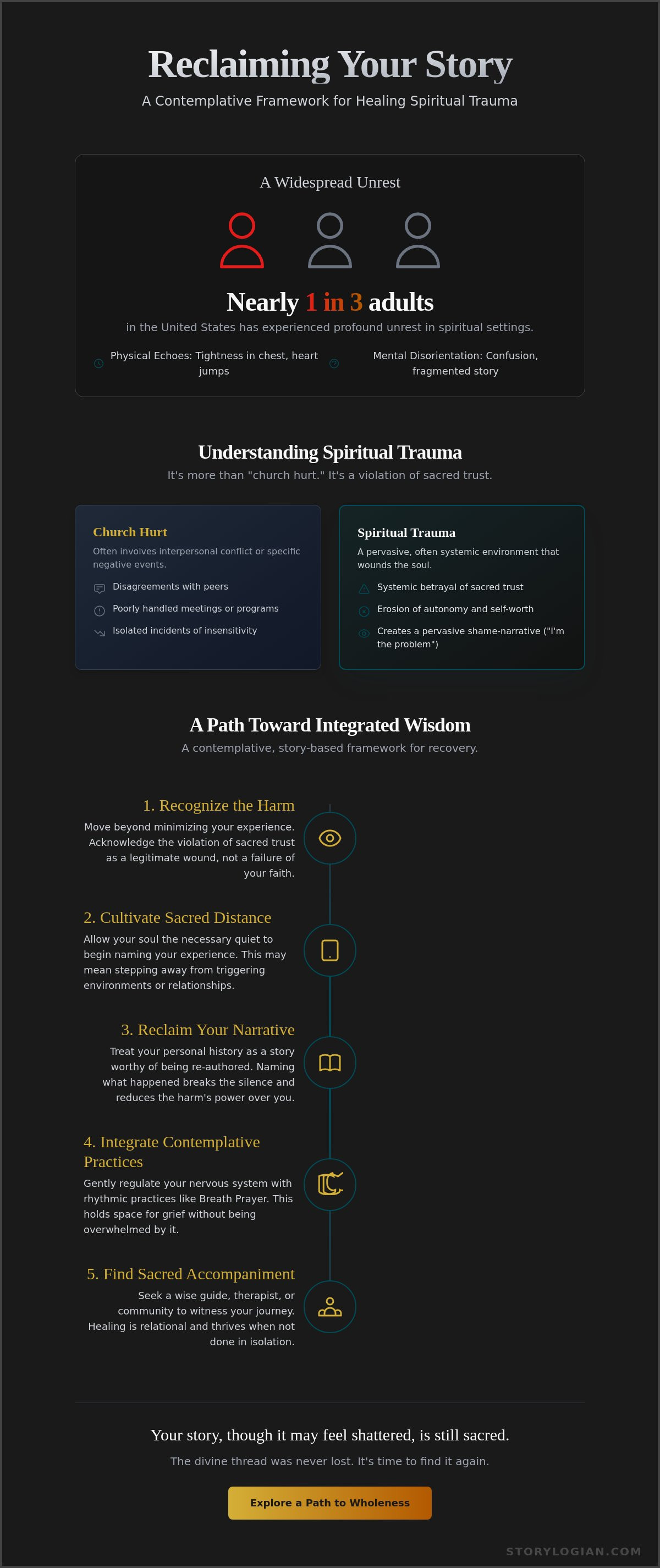
What if the tightness in your chest at the sound of a hymn isn't a sign of a failing faith, but a sacred signal that your story is asking to be heard? For nearly one in three adults in the United States, the sanctuary has become a place of profound unrest rather than rest. You might find your heart jumping to your throat when you step into a church. You might feel a deep confusion between the character of God and the actions of those who claimed to speak for Him. Learning how to process spiritual trauma is not about finding a quick fix for your soul. It's a slow, rhythmic return to yourself.
It's exhausting to carry a shattered personal story that feels like it no longer belongs to you. You deserve a space where your history is honored, not managed. This guide offers a contemplative, story-based framework for naming the harm you've endured and reclaiming the sacredness of your journey. We'll explore how to move from a state of quiet unrest toward integrated wisdom, helping you find a path back to contemplative prayer where the pain no longer defines the person you're becoming.
Key Takeaways
Recognize spiritual trauma as a violation of sacred trust, moving beyond the immediate physical response toward a deeper understanding of your internal landscape.
Explore how to process spiritual trauma through the lens of narrative theology, treating your personal history as a story worthy of being re-authored with grace.
Cultivate a "sacred distance" from the environments of harm, allowing your soul the necessary quiet to begin naming the reality of your experience without minimization.
Integrate rhythmic contemplative practices, such as Breath Prayer, to hold space for grief while gently regulating your nervous system during moments of triggering.
Discover the transformative power of sacred accompaniment, finding a wise guide to witness your journey toward a restored capacity for prayer and integrated wisdom.
Table of Contents
Recognizing the Unspoken: What Is Spiritual Trauma?
The body remembers what the mind often tries to minimize. You may feel a sudden tightness in your chest or that familiar jump in the throat when a religious conversation begins. This isn't merely social anxiety. It's the physical echo of a violation that reached into the deepest parts of your identity. Spiritual trauma occurs when the sacred trust between an individual and their faith community is betrayed. It's a profound disruption. This experience can lead to what some researchers call Religious Trauma Syndrome, a condition where the very structures meant to provide meaning instead cause psychological distress. Understanding how to process spiritual trauma begins with acknowledging that this pain isn't a failure of faith. It's a response to a wounded narrative.
When our spiritual foundations are shaken, our personal story fragments. We lose the thread of who we are in relation to the Divine. This isn't a simple problem to be solved with a new set of beliefs. It's a deep-seated unrest that requires a gentle, patient approach to healing. By naming the harm, we begin the process of gathering the scattered pieces of our history. We start to see that our story, though shattered, is still sacred.
The Anatomy of a Sacred Betrayal
In spiritual settings, authority figures often carry a weight that transcends the ordinary. They aren't just leaders; they are often seen as gatekeepers to the Divine. When this power is used to manipulate or control, the damage is deep. "God-language" is frequently employed to mask unethical patterns, making it difficult for you to discern between the voice of a leader and the voice of the Creator. This confusion creates a fragmentation within the self. Spiritual trauma is the wounding of the soul’s primary connection to the Divine. It shatters the lens through which we view the world, leaving us to navigate a landscape that feels both familiar and terrifyingly foreign.
Naming the Harm: Beyond Church Hurt
We often hear the term "church hurt" used to describe a variety of experiences. However, there's a vital difference between a simple interpersonal conflict and systemic spiritual harm. Church hurt might involve a disagreement with a peer or a poorly handled meeting. Spiritual trauma is different. It is a pervasive, often systemic environment that erodes your autonomy and sense of self-worth. It leaves behind a shame-narrative that whispers you're the problem. You might find yourself wondering how to process spiritual trauma when the very people who caused the harm insist they were acting in love. Acknowledging the validity of your quiet unrest is the first step toward reclaiming your story. Your body is telling the truth about the harm, even when your community won't.
The Power of the Narrative: Why Story Matters in Healing
Trauma has a way of stopping the clock. It tethers us to a moment of violation, making it feel as though the story ended right there in the pews or the pastor's office. Narrative theology offers a different path. It suggests that our lives are a continuous, unfolding dialogue with the Infinite. When we consider how to process spiritual trauma, we must look beyond the immediate symptoms of distress. While a clinical perspective on spiritual trauma helps us understand the nervous system's response, narrative work addresses the soul's deep disorientation. It's about reclaiming the plot. By naming the specific ways our trust was broken, we begin to move again. We learn to see the sacred art of storytelling as a tool for wholeness, proving that the Divine thread in our history was never actually lost.
Naming your story is the first step toward spiritual freedom. It breaks the spell of silence that trauma casts over a life. When we refuse to speak the truth of what happened, the harm continues to live in the shadows, dictating our reactions and our prayers. Bringing these stories into the light doesn't make them go away, but it does change their power over us. It allows us to see the harm as an event that happened to us, rather than a definition of who we are.
Reclaiming Your Voice from the Shadows
The silencing effect of spiritual trauma is often quiet and pervasive. For many women, this harm is compounded by religious structures that prioritize institutional stability over individual truth. Your voice might have been buried under layers of "shoulds" and "musts." Storywork invites that voice to return. It helps you identify recurring themes of harm that you might have previously dismissed as normal. You begin to see your life not as a series of random accidents, but as a sacred text. This text is currently being re-authored by you. It is a slow process of taking back the narrative power that was taken from you in the name of faith. This reclamation is essential for anyone wondering how to process spiritual trauma with dignity.
The Role of Storywork in Recovery
Recovery requires a new set of eyes. Through storywork sessions, we create a framework for this new vision. By identifying the "characters" who played roles in your history and the "plots" that led to your wounding, you gain a necessary distance. This isn't a clinical detachment; it's a soulful perspective. You are no longer trapped inside the event. You are now the witness to it. This transition is where the healing deepens. You move from being a victim to being the one who tells the story. If you're seeking a way to integrate these painful chapters into a life of wisdom, sacred accompaniment can provide the space you need to breathe and begin again.
A Checklist for Recovery: Steps to Process Spiritual Trauma
Healing requires a map. It's not a straight line, but a slow circling toward the center of your own truth. When you're learning how to process spiritual trauma, you need more than just a list of tasks. You need a way to inhabit your own life again. This process begins with a quiet, firm refusal to minimize what you've endured. Acknowledging that the harm was real is the first movement toward wholeness. It's the act of saying that your pain matters more than the reputation of an institution.
True recovery often necessitates a "sacred distance." This is a deliberate stepping back from the environments, people, or rhythms that triggered your unrest. It creates a clearing where you can finally hear your own pulse. Within this clearing, we seek sacred accompaniment. Unlike a purely clinical approach, this is a soul-friendship that makes space for the Divine without the pressure of performance. It's about having a witness who can help you discern the difference between your true self and the "shame-narrative" you were taught to carry.
Internal Assessment: Naming the Theological Harm
A theological lie is a distortion of grace used for control. These are the scripts that were handed to you as truth, but functioned as chains. To begin the work of unlearning, you must identify which beliefs have become heavy burdens. Common distortions include:
The Test of Suffering: The idea that every pain is a divine test you must pass.
The Rebellion of Doubt: The claim that asking questions or dissenting is a sign of spiritual failure.
The Erasure of Self: The teaching that your needs, boundaries, and voice are obstacles to holiness.
Take a moment to breathe. List the beliefs that currently feel like lead in your soul. Naming them is the first step in laying them down.
External Boundaries: Creating a Contemplative Space
Stepping out of toxic cycles is an act of self-reverence. You cannot heal in the same environment that made you sick. This might mean a season of silence or a complete departure from a community. For those who have served in leadership, this transition is particularly complex. If you find yourself in this position, exploring soul care for ministry leaders can provide a framework for your own unhurried recovery. When evaluating the safety of any spiritual space, consider these markers:
Does this community honor my "no" without retaliation?
Is there room for complexity and unanswered questions?
Are the leaders accountable and transparent in their actions?
Does the culture prioritize the well-being of the individual over the growth of the organization?
By establishing these boundaries, you protect the fragile embers of your interior life. You give yourself permission to be weary. You give yourself permission to heal at a pace that honors your story.
The Architecture of Silence: Contemplative Tools for the Weary
Silence is a sanctuary. It's a place where the loud, demanding voices of institutional expectation finally begin to dim. When your trauma was born in a place of certainty and noise, stillness can feel like a threat. Yet, it is within this quiet that we find a holding space for the grief and confusion that dogma cannot reach. Silence acts as a filter for spiritual noise. It allows the echoes of harmful authority to fade so that your own internal rhythm can emerge. Learning how to process spiritual trauma requires building this architecture of silence, stone by stone, until it becomes a home where you can finally breathe without fear.
Beyond the stillness, we can find God in the small, safe threads of the day through the practice of the Examen. This isn't a rigorous self-audit. It's a gentle looking back to see where beauty or kindness flickered. You might find the sacred in the slant of afternoon light or the steady warmth of a cup of tea. For those whose connection to the Divine feels shattered, these tiny moments of Visio Divina, or sacred seeing, offer a way to find grace outside of rigid structures.
Breath Prayer and Nervous System Regulation
When triggers occur, your body reacts before your mind can catch up. You feel the pulse quicken. You feel the air leave your lungs. Understanding how to process spiritual trauma involves tending to these physiological responses with reverence. Breath prayer is a rhythmic way to regulate your nervous system while remaining grounded in the sacred. The ancient concept of Ruach, or God’s breath, reminds us that the Spirit is as close as our own respiration. To begin this practice, follow these steps:
Find a quiet seat and place your hands on your lap.
Inhale deeply and slowly, whispering or thinking: "I am safe."
Exhale fully, releasing the tension as you think: "I am held."
This simple movement honors the body as a temple of truth. It reminds you that you are not just a mind or a set of beliefs, but a living soul. For a deeper exploration of these rhythms, you can consult this contemplative prayer guide designed for those who are weary of traditional religious performance.
Finding the Sacred in the Ordinary
Healing often happens in the unhurried movement of a sacred walk. These are not exercises for fitness, but pilgrimages of the heart. As you walk, you notice the world as it is, without the filter of a sermon or a mandate. You might also find that journaling acts as a sacred witness to your own pain. By putting ink to paper, you give your grief a place to live outside of your own body. This externalization provides the distance needed to see your history with compassion. If you feel ready to move from silence into a guided exploration of your history, consider reclaiming your story through a dedicated session of soul-listening.
Sacred Accompaniment: Moving Toward Integrated Wholeness
Healing is rarely a straight line. It is a slow, circular journey where we return to the same painful memories, but with a new set of eyes and a more resilient heart. This process of integration requires a witness. We call this sacred accompaniment. It isn't a form of institutional supervision or a program to be completed. Instead, it's a soul-friendship rooted in deep discernment. When you are learning how to process spiritual trauma, having a guide who honors your autonomy is essential. This person doesn't seek to fix you. They seek to witness the work the Divine is already doing within your unrest.
A spiritual director is uniquely suited for this role because their focus remains on your interior landscape rather than institutional compliance. Unlike some religious leaders who may prioritize dogma over the individual, a safe guide offers humility and non-judgment. They are comfortable with your silence and your questions. You can recognize a safe companion by their capacity for deep listening. They don't offer easy answers or spiritual platitudes. Instead, they hold a lantern while you navigate the dark woods of your own history, ensuring you don't have to walk the path alone.
The Difference Between Therapy and Spiritual Direction
It's helpful to understand the distinct roles of clinical support and spiritual exploration. Therapy often focuses on symptom management and psychological health, which is vital for many survivors. Spiritual direction, however, focuses on the narrative of the soul. It asks where the Divine is present in the midst of the pain. You don't have to choose one over the other. In fact, many find that using both creates a more holistic path to recovery. If you are a woman seeking a space that honors your specific experience, exploring spiritual direction for women can help you find a companion who understands the nuances of your journey.
Your Story Is Still Being Written
The chapters of harm you've endured are significant, but they don't get the final word. Your story is still being written. The trauma is a chapter, not the entire book. As you discover how to process spiritual trauma, you'll find that the shattered pieces of your history can be integrated into a new, wiser narrative. You're invited to consider a Storywork Intensive to begin this intentional work of re-authoring your life. There is no rush. Your soul is a sacred landscape that deserves an unhurried pace. As the old contemplative wisdom suggests, the soul does not grow by addition, but by subtraction, clearing away the noise until only the truth remains.
Reclaiming the Sacred Thread of Your Story
The path toward wholeness is not about erasing the chapters of pain. It's about learning how to process spiritual trauma with the same patience and reverence the Divine has for your soul. You've explored how to name the unspoken harm, the power of reclaiming your narrative, and the contemplative tools that provide a holding space for your grief. These movements are the beginning of a life where your history is no longer a source of shame, but a wellspring of integrated wisdom.
You don't have to navigate this interior landscape alone. A sacred, contemplative environment is available for those seeking deep listening and a specialized focus on narrative and Christian storywork. Led by Dr. Shonda Carter, a theologian and spiritual director, these sessions offer a place where your history is treated with the dignity it deserves. This is a shared journey toward truth and freedom. It's a process of returning to the sacredness of your own history.
Begin your journey of re-authoring with a Storywork Session. Your story is not a finished book. It's a living narrative, and the most beautiful chapters are still waiting to be written.
Frequently Asked Questions
Is spiritual trauma the same as religious trauma syndrome?
Spiritual trauma and Religious Trauma Syndrome describe similar landscapes of sacred violation. While the latter is often used as a clinical term, the former addresses the soulful disruption of your primary connection to the Divine. Both terms acknowledge that the harm you experienced was real and deep. Understanding these definitions helps you name the weight you've been carrying as you learn how to process spiritual trauma.
How do I know if I am ready to process my spiritual trauma?
You are ready when the desire to reclaim your story begins to outweigh the fear of looking back at the pain. Readiness doesn't mean you feel strong or certain. It often looks like a quiet, persistent nudge to seek a holding space where your history can be honored without judgment. If you're longing for a sense of integrated wisdom, your soul is likely ready to begin.
Can I heal from church hurt without leaving my church?
Healing while remaining in the same environment is possible but requires clear boundaries and a commitment to your internal safety. It's only feasible if the community is willing to acknowledge the harm and change its patterns. However, your soul's well-being must always be the priority. Many find that a season of sacred distance is necessary to hear their own voice again without the noise of institutional expectation.
How long does it typically take to process spiritual trauma?
Healing is a rhythmic, unhurried process that doesn't follow a clinical timeline. Some layers of your story may settle quickly, while others require years of patient reflection. You aren't failing if your progress feels slow. The goal isn't to reach a destination, but to move toward a state of wholeness where the harm no longer defines your daily life or your capacity for prayer.
What is the role of a spiritual director in trauma recovery?
A spiritual director acts as a witness and a soul-friend who helps you discern the Divine thread in your history. They don't offer clinical mental health counseling or institutional advice. Instead, they provide a space of deep listening where you can safely explore how to process spiritual trauma and reclaim your voice. They help you distinguish between the voice of your trauma and the voice of the Spirit.
Is it possible to find God again after spiritual abuse?
It's entirely possible to find a connection to the Divine that is free from the distortions of abuse. This often requires a season of unlearning the theological lies that were used to control you. As you heal, you might discover a God who is much more gentle and expansive than the one presented in your past. This new connection is often built on the foundations of honesty and personal autonomy.
How do I explain my spiritual trauma to friends who are still in the community?
You don't owe anyone an explanation that compromises your peace. If you choose to speak, focus on your internal experience rather than trying to convince them of the community's flaws. Use simple, honest language about your need for distance and the quiet unrest you've been carrying. True friends will honor your need for safety, even if they don't fully understand the depth of your journey.
What should I do if I feel triggered during a church service?
Honor your body's signal by stepping out of the service the moment you feel the jump in the throat. You don't need to apologize for protecting your peace. Once you're in a quiet space, use a contemplative tool like Breath Prayer to ground yourself. Remind your heart that you're safe in the present moment and that your story is your own to protect, regardless of social expectations.



Comments