The Sacred Gift of Being Seen: 7 Profound Benefits of Spiritual Direction

What if the most radical act of faith you could perform today isn't a new spiritual discipline, but the simple choice to be truly seen? Perhaps you've felt the exhaustion of over-functioning in a church setting that doesn't have room for your questions. Maybe you're struggling to find the divine in a history marked by harm; feeling as though your connection to the sacred has frayed beyond repair. It's a heavy burden to carry a story that feels unheard. Understanding the benefits of spiritual direction begins here, in the recognition that your soul requires a witness rather than a taskmaster.
You aren't alone in that quiet unrest. With over 65% of millennials and Gen Z now actively investing in spiritual wellness, it's clear that many are seeking a depth that traditional structures often miss. We know the desire for a faith that feels integrated rather than performative. This ancient practice offers a space of sacred accompaniment where your narrative is honored as a holy text. By slowing down, you can learn to discern God’s presence in your history and re-author your life with clarity. We will explore how this unhurried witnessing leads to emotional healing and a profound sense of divine nearness.
Key Takeaways
Uncover the transformative benefits of spiritual direction by moving beyond one-sided prayer into a space where your soul is truly witnessed.
Learn to cultivate a heightened self-awareness that honors your unique design and provides a personal language for your experiences with the Divine.
Discern the vital distinction between clinical therapy and spiritual accompaniment, where the focus is on the Holy Spirit’s movement rather than psychological fixing.
Discover how to treat your life as a sacred text, identifying the "Divine Thread" that weaves through seasons of both deep joy and past harm.
Gain a clear understanding of what a session of sacred accompaniment entails and how to prepare your heart for unhurried, prayerful reflection.
Table of Contents
The Quiet Need for Sacred Witness in an Unhurried World
We live in a world that demands a loud, visible existence. We're told to produce, to perform, and to present a curated version of our faith to those around us. But what happens to the parts of us that don't fit into a status update or a Sunday morning service? Our souls become fragmented. We carry stories that have never been told; because they've never been told, they feel heavy and disconnected from our actual lives. One of the primary benefits of spiritual direction is the invitation to step out of this noise and into a space where your internal landscape is treated with the reverence it deserves.
In many traditional church settings, prayer can feel like a one-sided monologue. We speak into the silence, hoping for a response but often feeling only the echo of our own anxiety. Spiritual direction shifts this dynamic. It isn't a conversation about God as much as it is a conversation with God, facilitated by a human guide who acts as a holder of sacred space. This person doesn't speak for the Divine. Instead, they help you listen to the whispers that are already present in your life. They help you move from the frantic pace of productivity toward the restorative silence of the soul.
The Cost of an Unwitnessed Spiritual Life
When our spiritual experiences remain suppressed, we often drift into a state of stagnation. We feel stuck because we haven't named the reality of our journey. In a safe, non-judgmental container, you're invited to speak the truth of your doubt or your delight. True spiritual formation doesn't happen through "fixing" or correcting your path. It happens through the gentle act of witnessing, which allows the fragmented pieces of your story to find their way back home. It's in the naming that the healing begins.
Sacred Accompaniment as an Antidote to Burnout
A culture of constant demand leaves little room for the unhurried soul. For those in leadership, the pressure to "be" the faith for others is a weight that eventually breaks. This practice provides a sanctuary for soul care for ministry leaders who are weary of performing. Laying down the burden of being the expert allows you to simply be a child of God again. You'll find the benefits of spiritual direction in the quiet relief of being known without having to achieve or explain your worth.
Core Benefits of Spiritual Direction for the Modern Seeker
In the rush of the modern world, our internal compass often loses its north. We become experts at reacting to external stimuli while remaining strangers to our own hearts. One of the most vital benefits of spiritual direction is the cultivation of a heightened self-awareness that honors your unique design. This isn't self-absorption; it's self-stewardship. By paying attention to the way you're wired, you begin to develop a nuanced and personal language for the Divine. This language resonates with your specific history and temperament, moving you away from borrowed prayers and into an authentic dialogue with the Creator.
This practice offers the profound gift of presence. It validates your feelings as legitimate components of your spiritual journey rather than distractions to be suppressed. When faith and feeling are integrated, emotional regulation becomes a natural byproduct of a soul that feels safe. If you're ready to explore these benefits of spiritual direction in your own life, you might consider beginning a season of sacred accompaniment to help you navigate the terrain of your heart.
Cultivating a Deepened Internal Awareness
A spiritual director serves as a sacred mirror. In their presence, you can see the patterns of your life that usually remain hidden in the shadows of busyness. They help you distinguish between the "ego voice," that frantic internal critic demanding perfection, and the "Spirit’s invitation," which is often a gentle, persistent tug toward rest or truth. Through contemplative listening, you uncover desires that have been buried under the weight of expectation. You allow these hidden parts of yourself to finally breathe and speak.
Finding God in the Ordinary
We often look for God only on the mountain tops, in the grand revelations or the emotional highs of a retreat. Spiritual direction shifts the lens toward the ordinary. It teaches you that the burning bush is just as likely to be found in the kitchen sink or the quiet hum of an office. By practicing tools like the Examen, you learn to sift through the day’s debris to find the gold of God’s presence in the mundane rhythms of work and home. The sacred isn't reserved for the sanctuary; it's woven into the very fabric of your lived experience. You begin to recognize that every moment carries the potential for a divine encounter if you have the eyes to see it.
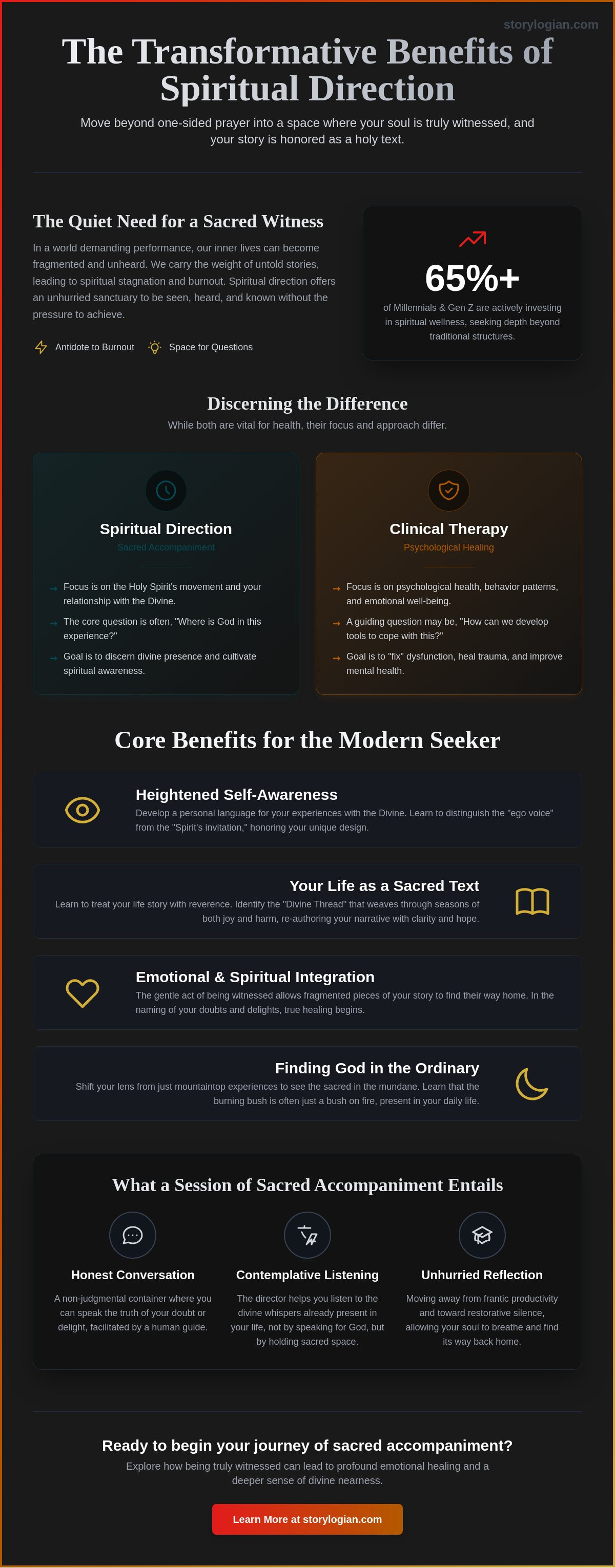
Discerning the Difference: Spiritual Direction vs. Therapy
It's a question often whispered in the threshold of a first session: "Is this just another form of counseling?" It's a natural inquiry. Both paths seek the restoration of the human person, yet they navigate different landscapes of the interior life. While clinical counseling often focuses on the repair of the psyche and behavioral health, the benefits of spiritual direction emerge from a different posture. This practice isn't about fixing what is broken, but about noticing what is holy. It is an ancient art of accompaniment that treats your life not as a puzzle to be solved, but as a mystery to be inhabited.
In this space, the term "Director" can be somewhat misleading. The human guide doesn't command or dictate your path. Instead, they acknowledge that the true Director is the Holy Spirit. The human companion simply holds the lantern, helping you see where the Divine is already moving. These two practices don't compete; they complement. Many find that a season of therapy provides the emotional stability necessary to dive deeper into the contemplative waters of sacred accompaniment. Together, they offer a holistic approach to a life that is both psychologically healthy and spiritually integrated.
The Focus of the Session: Psychology vs. Pneumatology
Therapy is primarily concerned with the "self." It explores family systems, trauma, and cognitive patterns to improve one's quality of life. Spiritual direction shifts the lens to the "Self-with-God." The focus is pneumatological, meaning it centers on the breath and movement of the Spirit within your daily experience. Every session involves a "Third Guest." You and your guide are both listening to a Voice that is deeper than your own. You'll know it's time for a director when your primary longing isn't just to feel better, but to know God more intimately in the midst of your reality.
The Role of the Director as a Sacred Guide
A director doesn't diagnose. They don't offer a clinical solution to your spiritual unrest. Instead, they witness and wonder. They use the power of the poignant question to help you uncover your own internal wisdom. This approach honors your autonomy, ensuring that the discernment remains yours. You aren't being led to a predetermined conclusion; you're being invited to a deeper encounter. By stepping away from the need for a "fix," you discover the benefits of spiritual direction in the freedom to simply be, exactly as you are, in the presence of the One who loves you.
The Transformative Power of Narrative and Storywork
Your life is more than a sequence of random events. It is a sacred text. It's a living, breathing testament of grace, written with the ink of your actual days. One of the most profound benefits of spiritual direction is the opportunity to sit with a witness and look at the pages of your history with fresh eyes. We often view our past as a collection of disjointed scenes, some we'd rather delete. Yet, when we slow down, we begin to identify the "Divine Thread" that weaves through every season. This thread doesn't just exist in the moments of light. It's present in the shadows too, binding the fragments of your experience into a meaningful whole.
By treating your history with reverence, you move away from the spiritual fragmentation that so often leads to burnout. You begin to understand that your story isn't a distraction from your faith; it is the very place where your faith is formed. This realization changes how you walk through the world. You no longer see yourself as a passive recipient of circumstances, but as a participant in a grand, ongoing narrative of redemption. If you find yourself longing to make sense of the chapters that feel unfinished, engaging in Storywork Sessions can provide the clarity you need to move forward.
Finding the Sacred in Your Personal History
Naming your story is an act of liberation. It's the first step toward spiritual freedom. Many of us carry "church hurt" or spiritual wounds that have silenced our own experiences. By engaging in the sacred art of storytelling, you allow those wounds to be witnessed without being judged. You start to recognize God’s redemptive work even in the chapters that felt like abandonment. You aren't just a character in a story. You are a co-author with the Divine, discovering that no part of your history is outside the reach of grace.
Re-Authoring Your Narrative of Hope
Trauma often creates a "closed" story. It's a narrative that feels finished, defined entirely by what was lost or taken. Spiritual direction helps you move toward an "open" narrative. Through storywork sessions, you can reclaim your voice after it has been stifled by harm or expectation. You learn to integrate your past into a whole, holy present. This isn't about rewriting the facts of what happened. It's about re-authoring the meaning of those facts through a lens of compassion and hope. You discover that the benefits of spiritual direction extend into every corner of your identity, allowing you to breathe again in the middle of your own prose.
Embarking on the Journey of Sacred Accompaniment
The journey toward a more integrated soul begins with a single, unhurried breath. It's the moment you decide that your story is worth the time it takes to tell it. Transitioning from the conceptual understanding of the benefits of spiritual direction to the actual practice of being seen is a sacred threshold. It requires a gentle shift in posture. You aren't showing up to achieve a goal or to check a box on a spiritual to-do list. Instead, you are arriving to simply be. You are setting an intention to listen for the Voice that often gets drowned out by the static of a busy life.
Knowing if you are ready for this contemplative commitment often comes as a quiet pull rather than a loud command. It's a sense that the old ways of relating to the Divine no longer fit the person you are becoming. If you find yourself longing for a space where your questions are more important than your answers, you're likely ready. This is a commitment to the long, slow work of the Spirit. It's a choice to value depth over speed and presence over productivity.
What to Expect in Your First Session
A typical session of sacred accompaniment feels less like a business meeting and more like a visit with a trusted friend of the soul. There is a specific, prayerful rhythm to the hour. Silence is often invited in as a guest, providing a buffer between the noise of the outside world and the quiet of the interior landscape. You might engage with a short passage of Scripture or a poignant question that acts as a mirror for your current season. There is no "right way" to show up. You can arrive with a heavy heart, a specific discernment question, or even a sense of holy emptiness. Most direction relationships find a healthy rhythm meeting once a month; this allows the insights gathered in the session to settle into the soil of your daily life before the next conversation.
Finding the Right Guide for Your Soul
Choosing a director is an act of discernment in itself. You aren't just looking for a resume; you are looking for a "chemistry of the soul." It's essential to find a guide who aligns with your narrative needs and understands the unique landscape of your history. A good director doesn't lead from the front. They walk beside you, honoring your autonomy and the specific way God is speaking to you. They are a holder of space, someone comfortable with the unspoken elements of your experience. If you feel a resonance with this unhurried approach, you can inquire about individual sessions with Dr. Carter. Taking this first step is an invitation to experience the benefits of spiritual direction firsthand, allowing your life to be witnessed in a way that leads to lasting peace.
Honoring the Prose of Your Soul
Your life is a holy text that deserves to be read with care. We've explored how the benefits of spiritual direction offer a sanctuary from the noise of performance; allowing you to discern the Divine Thread woven through your unique history. By distinguishing between the clinical needs of the mind and the contemplative needs of the soul, you can move toward a faith that feels integrated, honest, and deeply personal. It's a journey of returning to yourself and to the One who has been present in every unrecorded moment.
This is the work of a lifetime, but you don't have to walk the path alone. Begin your journey of sacred accompaniment with Dr. Shonda Carter. As a theologian and filmmaker, Dr. Carter offers a specialized integration of narrative storywork and spiritual formation. Her approach provides a safe container for women and ministry leaders to witness their own stories with fresh eyes and reclaimed hope. Peace is found in the slow, deliberate act of being seen. Trust that your narrative is still unfolding, and every chapter is held in grace.
Frequently Asked Questions
What is the primary difference between spiritual direction and pastoral counseling?
Spiritual direction focuses on your ongoing relationship with the Divine; pastoral counseling often centers on solving a specific life crisis or navigating a moral dilemma. While a pastor might offer advice or instruction based on church doctrine, a spiritual director acts as a companion who helps you listen to the Spirit’s voice within your own life. The goal isn't to fix a problem but to notice a presence.
How often should I meet with a spiritual director to see real benefits?
Most people find that meeting once a month provides the most significant benefits of spiritual direction. This four-week rhythm allows the insights from your session to settle into the soil of your daily life. It creates a steady, unhurried pace that honors the slow movement of the soul rather than the frantic speed of the modern world.
Can I benefit from spiritual direction if I am currently experiencing spiritual dryness?
Spiritual dryness is one of the most common reasons individuals seek sacred accompaniment. The desert seasons of faith aren't signs of failure; they are often the places where the deepest transformation occurs. A director helps you inhabit the silence without fear, looking for the subtle ways God is present even when the emotional experience of faith feels absent.
Is spiritual direction only for people in ministry or "super-spiritual" Christians?
Spiritual direction is for anyone who feels a pull toward a deeper, more integrated internal life. It’s particularly helpful for those who feel unheard in traditional settings or who are exhausted by religious performance. You don't need a title or a perfect prayer life to enter this space. You only need a desire to be seen and a willingness to listen.
What should I talk about in a spiritual direction session if I feel like nothing is happening?
The feeling that nothing is happening is actually perfect material for a session. You might explore the frustration of the silence or the mundane details of your work week. Often, the Spirit is most active in the ordinary rhythms we tend to overlook. Bringing your boredom or your sense of emptiness to the session allows those experiences to be witnessed and sanctified.
How does storywork integrate with traditional spiritual direction practices?
Storywork adds a narrative depth to the contemplative focus of spiritual direction. While traditional direction looks at the Spirit’s movement in the present, storywork invites you to look back at your history to find the Divine Thread in your past. Together, they help you re-author your life story through a lens of grace, ensuring your history and your future feel like one whole garment.
Is spiritual direction a safe place to process church hurt or religious trauma?
Spiritual direction provides a non-judgmental container specifically designed for processing spiritual wounds. Because a director isn't there to defend an institution or enforce a dogma, you're free to speak the truth of your harm. This sacred witness allows you to untangle God from the people or systems that caused pain, creating a pathway toward healing.
What are the long-term emotional benefits of sustained spiritual accompaniment?
Sustained accompaniment leads to a profound sense of emotional and spiritual integration. Over time, you'll likely notice a decrease in spiritual burnout and a heightened ability to regulate your emotions through a deeper awareness of God’s nearness. One of the primary benefits of spiritual direction is the lasting peace that comes from knowing you are seen, known, and held in every season.



Comments