How to Find a Spiritual Director: A Gentle Guide to Sacred Accompaniment

With only 30% of adults reporting high trust in religious leadership today, the search for a safe, sacred space has never felt more urgent. You may feel the weight of this disconnect in your own bones. You are tired of being unseen. You are weary of the noise. When you seek to find a spiritual director, you're looking for more than a program; you're looking for a witness who honors the complexity of your unique narrative without trying to fix it.
We believe your spiritual journey deserves to be handled with reverence and a slow, deliberate grace. You deserve to move from a state of quiet unrest toward a sense of integrated wisdom. This guide will walk you through the prayerful steps of discernment to find a guide who offers true sacred accompaniment. We'll explore how to identify a companion who can hold space for your questions, helping you integrate your past stories with the faith you carry today.
Key Takeaways
Recognize the difference between seeking a quick solution and honoring the quiet nudge toward a witness for your soul's journey.
Learn the prayerful steps to find a spiritual director who resonates with your personal history and honors your spiritual autonomy.
Identify the essential qualities of a sacred guide, including their capacity for deep listening and their reverence for the unspoken.
Equip yourself with discernment questions to ensure your chosen companion can safely hold space for both your joy and your spiritual wounds.
Discover how sacred accompaniment allows you to re-author your life story through a lens of grace and integrated wisdom.
Table of Contents
Recognizing the Call: Why You Seek a Spiritual Companion Now
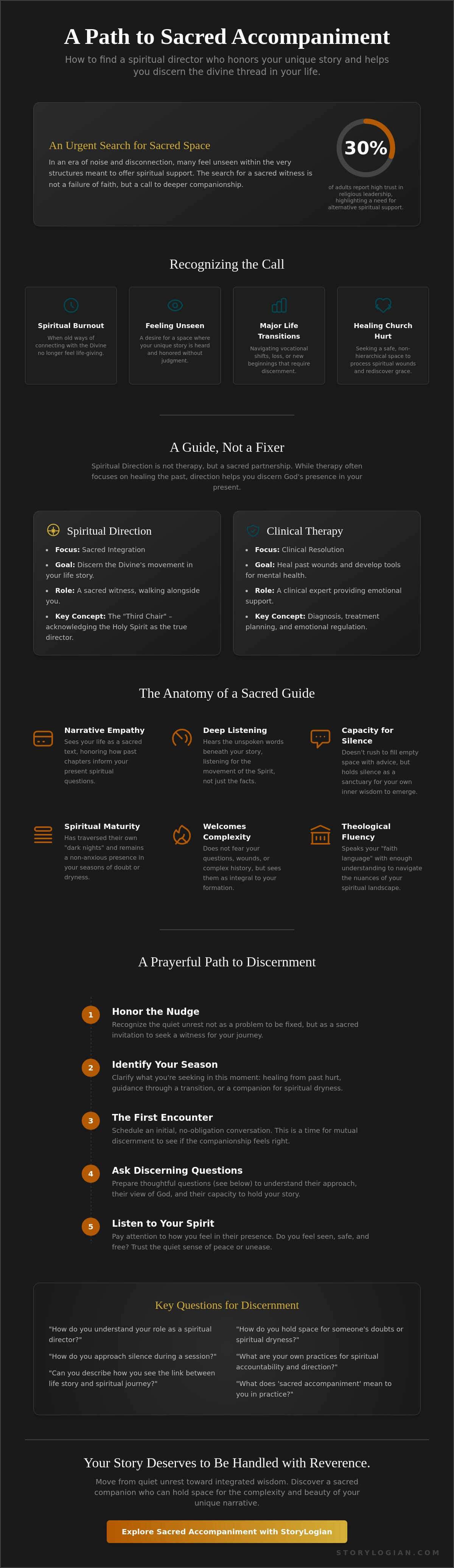
The nudge usually arrives in the silence. It's a persistent, quiet unrest that whispers of something more than the Sunday morning routine or the transactional nature of modern life. You might feel a sense of spiritual burnout. You might feel unseen within the very structures meant to hold you. This isn't a failure of faith; it's a call to deeper companionship. With only 30% of U.S. adults reporting high trust in clergy according to Lifeway Research in January 2026, it's natural to seek a sacred space outside traditional hierarchies. When you look to find a spiritual director, you aren't seeking a coach to optimize your prayer life or a consultant to fix your doubts. You're looking for a sacred witness. Spiritual direction is an ancient practice designed to help you listen to the movements of the Divine within your own story.
Moving beyond the "fix-it" mentality requires a shift in posture. In our culture, we're taught to treat every discomfort as a problem to be solved with a five-step plan. Spiritual companionship rejects this urgency. It's not about advice-giving or moral policing. Instead, it's about sacred accompaniment. It's the process of someone walking beside you, holding a lantern so you can see the path already beneath your feet. This is especially vital for women in transition who often find their voices buried under the weight of expectations. You don't need another person telling you what to do. You need a space where you are finally, fully seen.
The Difference Between Direction and Therapy
Clinical support is vital for healing the wounds of the past. It offers tools for mental health and emotional regulation. Spiritual direction, however, focuses on the "Third Chair." This is the quiet acknowledgment that the Holy Spirit is the true director in the room. While a counselor might help you navigate your history, a spiritual companion helps you discern how God is speaking through that history in this present moment. It's less about clinical resolution and more about sacred integration. You don't come to be fixed; you come to be seen and to listen.
Identifying Your Season of Need
Every soul moves through seasons. Some find themselves in a desert of dryness where the old ways of connecting with God no longer bear fruit. Others are on a mountain of transition, facing vocational shifts that require a steady, discerning presence. For many, the need arises from a place of healing from church hurt. In these moments, the noise of the world and the expectations of tradition can drown out the still, small voice. A director offers a sanctuary of silence. They help you sift through the noise to find the thread of grace that has been running through your life all along as you find a spiritual director who truly understands your heart.
The Anatomy of a Sacred Guide: Qualities to Look For
Finding a guide for your soul is an act of deep discernment. It's not a transactional search for an expert; it's the prayerful pursuit of a "soul friend" who can mirror the Divine back to you. When you begin to find a spiritual director, you're looking for someone whose presence creates a sanctuary. They must possess the rare ability to hold silence. They don't rush to fill the gaps with platitudes or advice. This capacity for deep listening is the foundation of sacred accompaniment, allowing your own inner voice to rise to the surface. You might wonder, What is Spiritual Direction? At its heart, it's the art of being present to another's presence with God.
A sacred guide should also possess significant spiritual maturity. They've likely traversed their own "dark nights" and understand that the path of faith is rarely a straight line. This maturity allows them to remain steady when you encounter your own seasons of doubt or dryness. They don't fear your complexity. Instead, they welcome it as the raw material of your spiritual formation. It's also helpful to seek theological alignment. While a director doesn't need to agree with you on every point of doctrine, they should speak your faith language with enough fluency to understand the nuances of your internal landscape.
The Gift of Narrative-Informed Direction
Your life is a story being written by a Divine hand. A director with narrative empathy understands that your current spiritual struggles are often rooted in the chapters you've already lived. They look for the "Divine Thread" woven through your ordinary days. This is where storywork sessions can become a powerful companion to direction. By honoring the sacredness of your personal history, you begin to see how your past isn't just a series of events; it's a landscape where God has always been present. If you feel called to this deeper exploration, seeking Sacred Accompaniment can offer the witness you've been longing for.
Credentialing and Ethics in Spiritual Care
Safety is the prerequisite for sacredness. While the connection is spiritual, the container must be professional and ethical. A reputable director adheres to the Guidelines for Ethical Conduct established by organizations like Spiritual Directors International, which remains the gold standard in 2026. They should also be committed to their own ongoing supervision. This ensures they're tending to their own "soul care" and aren't bringing their own unexamined baggage into your sessions. When you find a spiritual director who is accountable and well-trained, you create a space where true vulnerability can flourish without fear.
A Step-by-Step Path to Finding Your Spiritual Director
Seeking a companion is not a search for a service. It's a response to a holy invitation. Before you open a browser, open your heart. Begin in the quiet. Ask for the gift of a "soul friend" to be made known to you. This internal preparation distinguishes your journey from a mere consumer choice. It's the first movement of discernment. When you eventually find a spiritual director, you'll realize the search was part of the formation itself.
Once you've settled your heart, you can begin the practical work. Look toward contemplative communities and established networks. While directories provide names, your task is to look for resonance. Narrow your search based on your specific needs. If you carry the weight of spiritual harm, seek a guide who is explicitly trauma-informed. If you feel called to re-examine the chapters of your life, look for those who specialize in story-focused care. This intentionality ensures your guide can honor the unique contours of your narrative.
Where to Start Your Search
Utilize national networks like Spiritual Directors International (SDI) or specialized Christian storywork platforms. In 2026, the rise of virtual accompaniment has removed geographic barriers. You can now prioritize the "soul fit" over zip codes. Seek recommendations from trusted contemplative leaders or mentors who understand your spiritual language. Look for directors who describe their practice with a sense of reverence rather than clinical jargon. Accessibility is a gift, but alignment is the goal.
Evaluating the "Soul Fit"
The first encounter is a moment of shared discernment. Pay attention to your body. Does their voice and presence invite you to slow down and breathe? Safety is not just an idea; it's a felt experience. You should feel a quiet permission to bring your "shadow" stories into the light without fear of judgment. After your first interaction, try to describe the resonance in a single sentence to capture your intuition. Your description might be: "I felt a steady sense of being held in a space where silence was welcome and my story was safe."
Commit to a trial period of three sessions before making a long-term choice. The first meeting is often just an introduction. The second allows for the initial awkwardness to fade. By the third, you'll begin to see if a rhythm of sacred listening is truly forming. Trust the process. This is a slow work, and your soul knows the way.
The First Encounter: Questions for Your Initial Discernment
The initial meeting is a threshold. It's a quiet space where two souls lean in to see if a shared rhythm is possible. As you seek to find a spiritual director, your questions should serve as lanterns, illuminating the heart of the person sitting across from you. This is especially true if your journey has been marked by the shadows of spiritual harm. With trust in traditional religious structures reaching a documented low of 30% in early 2026, the safety of this container is paramount. You aren't just looking for credentials. You're looking for a safe harbor for your story.
Begin by asking how they describe the role of the Holy Spirit in your sessions. A sacred guide understands they're not the primary actor in the room; they're a witness to the "Third Chair." Inquire deeply about their approach to church trauma. If you've felt unseen or silenced in the past, you need to know your director can hold your grief without rushing to defend an institution. Consider asking these heart-centered questions:
How do you incorporate contemplative practices or storytelling into our time together?
What does a typical session look like in your practice?
How do you hold space for stories that feel messy or unresolved?
A guide who honors your narrative will see your life not as a series of problems to be solved, but as a sacred text to be read with reverence. They'll wait for the Spirit to move rather than forcing a conclusion.
Questions About Their Practice
Inquire about their own history with spiritual direction and their formal training. It's vital to know your guide is also being guided. Ask how they handle moments of spiritual dryness or silence in a session. Their answer reveals if they're comfortable with the unspoken elements of your experience. Understanding the benefits of spiritual direction through their lens helps you see if their vision aligns with your soul's desire for integration.
Navigating Logistics with Grace
Discuss fees as a "sacred exchange" that honors the time and presence offered. Many directors utilize sliding scales to ensure accessibility. Establish a rhythm that feels sustainable. While monthly sessions are traditional, you might find that Sacred Accompaniment is what your current season requires. Clarify the boundaries of the relationship early on. This clarity creates the safety necessary for true vulnerability to emerge.
StoryLogian: Sacred Accompaniment for Your Unique Narrative
In the quiet quest to find a spiritual director, you eventually arrive at a threshold where your story meets a witness. At StoryLogian, this meeting is treated with the highest reverence. The approach here is not a standard one. It integrates the deep listening of spiritual direction with the narrative precision of filmmaking and the grounding of theology. Dr. Shonda Carter has cultivated a space specifically for women who are weary of being misunderstood or overlooked. She understands that your history is not a problem to be solved or a past to be escaped. Instead, it is a holy text. It is a living document where the Divine has been writing grace into every chapter, even the ones that feel broken or unresolved.
Traditional models often focus on institutional compliance or correcting the present moment. Sacred accompaniment at StoryLogian looks at the whole arc of your life. It honors the "Divine Thread" that has always been there, weaving through your joys and your silences. This is a shared journey. It is a methodical, unhurried process of looking back to see how you can move forward with integrated wisdom. You aren't just another name in a directory. You are a unique narrative waiting to be honored with a sense of calm understanding.
The Power of Being Witnessed
There is a profound transformation that occurs when you are truly seen by another. When you engage in the sacred art of storytelling, you begin to reclaim the parts of yourself that have been lost in the noise of a frantic life. You move from the cold ache of feeling unseen to the warmth of being sacredly held. This accompaniment is intentional. It is designed to help you slow down long enough to hear the Divine Whisper that often gets drowned out by traditional structures or spiritual burnout. Your future is transformed when you finally understand the sacredness of your past.
Your Invitation to Journey
The path to finding a spiritual guide who honors your autonomy and your narrative ends in a gentle invitation. If you feel a resonance with this reflective approach, you can book an initial consultation with Dr. Shonda Carter. During your first story-focused session, expect a space of deep silence and profound listening. There is no rush here. We allow ideas to settle. We allow your story to breathe. Your history is worth the time it takes to tell it. It is worth the reverence of a witness who will not look away. When you are ready to find a spiritual director who sees you as a sacred narrative, the door is open for you to begin.
Stepping Into the Light of Your Own Story
The quiet nudge that brought you here is a holy invitation. You've learned to look for a guide who honors your narrative and to ask the questions that reveal a director's heart. To find a spiritual director is to choose a witness who will help you re-author your life through the lens of grace. It's a slow work. It requires patience and a willingness to be seen in the complexity of your own history. You don't have to carry the weight of your transitions or the echoes of spiritual burnout alone.
Dr. Shonda Carter serves as a theologian, filmmaker, and sacred guide for women across the US. Through national virtual sessions, she specializes in storywork and narrative healing, treating your life as a text worth reading with significant care. She invites you into a space where your past is handled with reverence and your current faith is met with empathy. Begin your journey of sacred accompaniment with Dr. Shonda Carter. Your story is sacred. It's time to let it be heard in the safety of a shared and holy silence.
Frequently Asked Questions
How much does a spiritual director usually cost?
Financial exchange in spiritual direction is often viewed as a sacred exchange that honors the time and presence of the guide. While rates vary across the country, many directors offer sliding scales to ensure that soul care remains accessible to those in different financial seasons. It's best to discuss this openly during your initial consultation to find a rhythm that feels sustainable for your life and your budget.
Can I find a spiritual director online if I don’t live near one?
You can absolutely find a spiritual director online, as the rise of virtual accompaniment has made sacred space accessible regardless of your zip code. Many women find that meeting via video allows them to remain in the comfort of their own sanctuary while still experiencing a deep, resonant connection with their guide. This flexibility ensures you can prioritize soul fit over physical proximity in your search.
What is the difference between a spiritual director and a mentor?
A mentor typically offers wisdom based on their own experiences to help you grow in specific skills or behaviors. In contrast, a spiritual director acts as a witness who helps you listen for the Divine voice in your own life. Their role isn't to tell you what to do or how to act, but to hold space for you to discern the movements of the Spirit within your unique narrative.
How often should I meet with my spiritual director?
Most individuals choose to meet with their director once a month. This rhythm allows enough time for the themes of your life to settle and for the Spirit's movements to become more visible. Some may choose more frequent storywork sessions during intense seasons of transition, while others find that a slower, monthly pace provides the necessary room to breathe and reflect between meetings.
What if I don’t feel a connection with my director after the first meeting?
It's important to honor your intuition if the resonance isn't there after the first threshold is crossed. Discernment is a holy process, and not every director will be the right fit for your current season. You're encouraged to communicate this gently or simply move toward another guide who feels like a safer harbor for your story. Your spiritual autonomy and comfort are always the priority.
Can a spiritual director help me if I am struggling with church hurt?
A spiritual director is uniquely equipped to walk with you through the shadows of church hurt or spiritual harm. Unlike traditional structures that may feel heavy with expectations, sacred accompaniment offers a sanctuary where your grief and questions are handled with reverence. It's a space to re-author your story through grace rather than through the lens of the trauma or disappointment you've experienced in the past.
Do I need to be a "devout" Christian to seek spiritual direction?
You don't need to feel devout or have a settled faith to seek this kind of companionship. Many who find a spiritual director are in the middle of a desert season or a time of profound questioning where traditional answers no longer suffice. This practice is for anyone who feels a quiet nudge toward deeper listening, regardless of whether their faith feels vibrant or fragile at this moment.
How do I know if I need a spiritual director or a therapist?
Therapy is essential for clinical healing and navigating mental health, whereas spiritual direction focuses on your relationship with the Divine. If you're seeking to resolve deep psychological wounds or clinical conditions, a therapist is the appropriate choice. If you're looking to discern God's presence in your daily life and integrate your story with your faith, you'll want to find a spiritual director to witness that process.


Comments